
Basic information
Location: Carrer d’Olot, s/n. Carretera del Carmel Barcelona
Qualification: xxxxx (5 on 5)
Present condition: The park has an enormous surface and the condition is not the same in all it, both in general terms the condition could be qualified as acceptable or good.
How to go to: Buses: 24, 25
Metro: L3 (Lesseps)
Visits: November to February from 10 to 18 h., March and October from 10 to 19 h., April and September from 10 to 20 h., May to August from 10 to 21 h.
Timings, prices and other information can vary, please verify it previously.
Available guidebooks: It is possible to buy in the bookshop of the Park – Llibreria LAIE – a guide on the Park Güell and also some other books and gifts on it and Gaudí the Modernisme (Catalan Art Nouveau) and Barcelona.
Handicapped accessibility: The Park is accessible for wheelchairs, but duly to the important drops and the big size of the park, some areas are difficult to be visited for handicapped people. Nevertheless, the essential areas must be visited.
Information: Phone: (34) 93 413 24 00.
Ruta del Modernisme
History and description
Designed by Antoni Gaudí i Cornet and built from 1900 to 1914.
The assignment of this project was made by the count of Güell as an aristocratic city-garden with single-family residences.
The project finally wasn’t a success and consequently it became a municipality property and since 1923 being transformed in a public park.
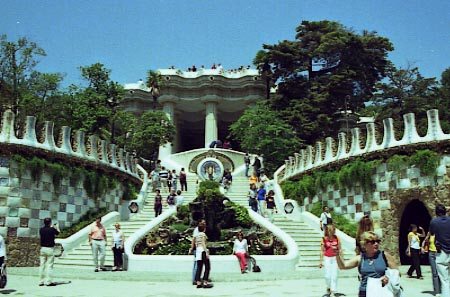
The main gateway show two administrative pavilions made in stone, Catalan vaults and covered of “trencadis” (surfaces covered with irregular ceramic pieces) who is also profusely present in the park and also in other Gaudí works and Art Nouveau architecture. Both roofs of that pavilions are crowned by original domes remembering mushrooms, the left building show a stylized tower with the Gaudí typical four branches cross.
Entering into the park, it is a stairway divided by different figures before to arrive to a colonnade hall with 86 massive columns sustaining the big square. It is interesting to look at the colored plafonds (designed by Josep Maria Jujol) on the roof.
The big square is a nice balcony overlooking Barcelona and the sea. The square is delimited by an undulated bench covered itself with “trencadis”. This large square is used as a place for cultural and popular meetings.
The park is developed around this central square.
A large network of serpentine paths with extraordinary architectural solutions is the perfect solution to walk quietly to enjoy nature and look at this Gaudí artwork.
Park Guell – Park Areas
Other Works of Gaudí
In Barcelona: Bellesguard | Eduard Calvet House | Batlló House | Vicens House | Santa Teresa School | Sagrada Família Schools | La Pedrera | Güell Pavilions | Güell PalacePark Güell | Sagrada Família | Miralles Property Fence
In La Pobla de Lillet: Catllaràs Villa | Artigas Gardens
In Mataró: Workers Cooperative building (attributed)
In Montserrat: Monumental Rosary path (1st mystery of Glory)
In Santa Coloma de Cervelló: Colònia Güell Crypt
In Garraf (Sitges): Garraf Cellars
Out of Catalonia: Botines House (León) | El Capricho (Comillas) | Episcopal Palace (Astorga)
