
Botines House
Basic information
Location: Plaza del Obispo Marcelo, 5 León Spain.
Qualification: xxx (3 on 5)
Present condition: Façades and interiors: Very good.
How to go: León is the capital of the province with the same name, located in the north west of the Iberic peninsula. To go to it from Madrid, far of 367 Km, take the N-VI road.
Visits: That building is at present, the seat of Caja España (a savings bank) and it is possible to visit the ground floor and the basement where, eventually some exhibitions are located. The visits time is the same of the opening hours of Caja España.
For a more comprehensive visit is it necessary to make an appointment.
Information: Phone: (34) 987 292 500 – email: Line@España.es
History
This building was entrusted to Gaudí by the company “Fernández and Andrés” of León (Spain) – succeeding of the business founded by mister Joan Homs i Botinàs (reason why the building is known under the name of Botines) -, that company was managed by Mrs. Simón Fernández Fernández and Mariano Andrés Luna that had commercial relations, due to his textile business, with the count Eusebi Güell who recommended them Gaudí as architect.
Gaudí worked then in the construction of the Episcopal Palace of Astorga (close to León) and due to the proximity of both buildings, he decided to accept the assignment.
Gaudí signed the plans of the building in December of 1891 and once surpassed the lawsuit that the owners had with the City Council, the works began January 4, 1892, directed by Claudi Alsina, and they were finished in November of the same year.
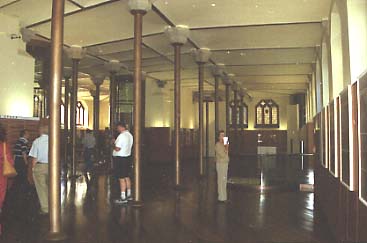
In the year 1931, the Caja de Ahorros y Monte de Piedad (a Savings Bank), acquired the building. This company carried out some reforms broking the original design eliminating seven pillars of the basement. Fortunately a new owner (Caja España – another Savings Bank), reconvert again the building to install in it its social headquarters, and carried out in the year 1994 a reform that restored the structure just as Gaudí had initially projected.
For this restoration, the architects Mariano Diaz Sáenz and Felix Compadre Díez were contracted to return to place the pillars eliminated previously, pillars that were reconstructed with the same materials used by Gaudí.
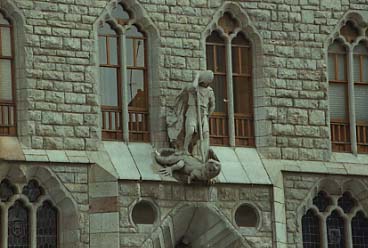
During these works, a paper roll with information on the construction aspects and collaborators of the initial works were found inside the statue of San Jorge – work of Antoni Cantó and Vicenç Matamala – presiding the main entrance, what has permitted a better knowledge of these aspects.
Description
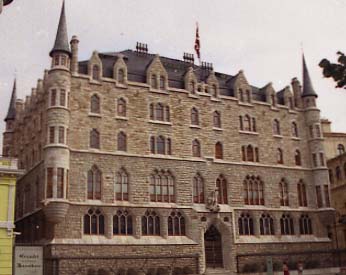
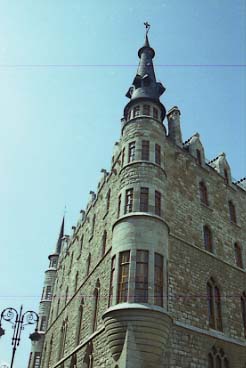
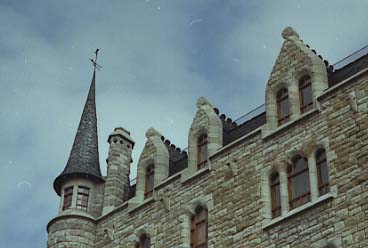
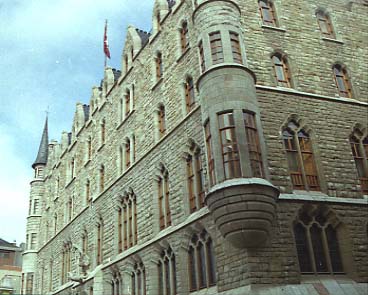
It is a rectangular building designed in a neo gothic style, but shown some very modern constructive characteristics for the period in which it was built. Really, despite the medieval aspect of the building, Gaudí applies a modern conception of the architecture so much in the constructive aspect, as in the artistic one and of utilization.
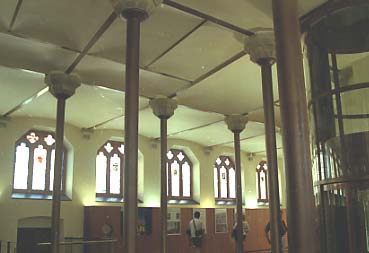
The structure of the building is supported by light metallic columns in the basement, permitting in this manner a more diaphanous space than was better adapted to the commercial needs that this area was devoted. In the upper flats, the function of support is trusted by load walls.
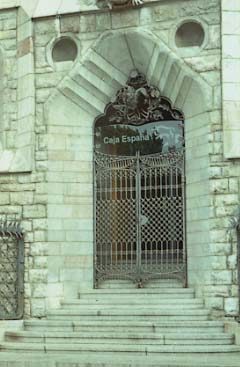
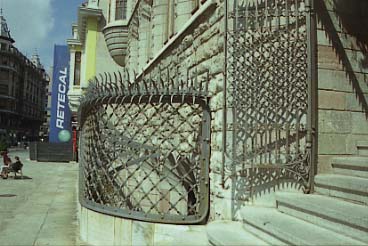
The access to the building is made through a door in the centre of the main façade, this is the only place where the ditch surrounding the front and lateral façades is broken to lead to the access stairs. On this door a statue of Saint George fighting with the dragon – mentioned in the section of history – is found, that door is closed with a notable forged iron grille in which we can observe a figure of a lion surrounded by vegetable motives evoking the name of the city.
To each angle of the four facades totally covered with blocks of of grey stone of local extraction, we find a circular tower. An important quantity of neo gothic windows in a bigger quantity in the low than in the higher plants, permit to assure a better lighting. In the upper plant, the lighting is also assured by some skylights, situated in the roof, simplifying also the ventilation, function helped by the six interior courtyards.
Above the basement and the ground floor, three levels are found plus an attic in addition. In the first one of these levels there are two apartments, one for each owner and in each one of the upper levels four flats destined to rent.
The roof is covered with grey shale.
Images



|
Specific Bibliography on Botines House |
|||
| Title | Author | Published by | Year |
BOOKS: |
|||
|
Soñando en piedra/ Dream in stone. León Gaudí 2002 |
Carriedo Tejero, M. and other |
Caja España y otras entidades de León y Astorga |
2002 |
|
Gaudí para jóvenes: León-Astorga. 150 aniversario del nacimiento del arquitecto |
Huerta, Fernando |
Ayuntamientos de León i Astorga, Fundación Vela Zanetti |
2002 |
El edificio Gaudí de León: Casa Botines |
Various authors |
Centro de Documentación de Caja España |
1997 |
ARTICLES: |
|||
|
Carriedo Tejedo, Manuel: Gaudí en el León de final de siglo. Un perfecto desconocido: Iniciativas culturales (Caja España), nº 21 – 1998 Gaudí en León y en Astorga: Revista "León en Madrid" (Casa de León en Madrid), nº 353 – 1998 Gaudí en la provincia de León (1889-1893): Nuevas iniciativas (Caja España), nº 15 – 2001 El San Jorge de Gaudí en "Casa Botines": Nuevas iniciativas (Caja España), nº 17 – 2002 La conexión catalana de Gaudí en León: Nuevas iniciativas (Caja España), nº 17 – 2002 Casa Botines, el nombre popular de una antigua "Casa de Cambio": Nuevas iniciativas (Caja España), nº 17, 2002 Relojes, carrillones y campanas en "Casa Botines": Nuevas iniciativas (Caja España), nº 18 – 2002 Catalanes en los "Caminos de Santiago". Gaudí en Comillas, en León y en Astorga: Nuevas iniciativas (Caja España), nº 20 2002.
Galán y Galindo, Ángel:
Lucas del Ser, Carmelo de: |
|||
