Art Nouveau in Europe
Art Nouveau in Europe
Before introducing the Catalan Art Nouveau (named in Catalan “Modernisme”), it is interesting to know it’s European context.
The Art Nouveau is an artistic movement developed from the end of XIX century to the first quarter of XX century.
The first references of Art Nouveau are in England with the works of John Ruskin (1819-1900), influenced by gothic art, he published an enormous quantity of books on literature, painting, architecture, sculpture, aesthetics, and a lot of other social themes. His extraordinary taste for any type of art allowed him to value both the primitive Italian painters, the English pre-Raphaelites or Turner. He was an art propagandist. His ideas had been influencing the Arts and Crafts movement who highlight the return to the nature, beautiful designs, graceful shapes, undulations, with a fascinating charm, in which are represented vegetables, flowers, insects, fishes, dragons and coloured birds. The Art Nouveau gets its expression in different art shapes, like stone front walls, ceramics, and forged iron, interiors with curved walls, frequently with an exuberant ornamentation.
The sculpture, painting and Fine arts, brought a new start to the themes selection and its representation.
Ruskin is interested by art, but in addition he also manifested the social and political consequences of Art, architecture and literature. These ideas had a big influence on arts and architecture all around Europe and America.
In England, Ruskin was followed by Edward Coley Burne-Jones (1833-1898), William Morris (1834-1896), Walter Crane (1845-1915) and others, basically through the mentioned Arts and Crafts movement, organized around the Art and Crafts Society founded in 1888, and helping a strong revival of arts. For those artists the beauty is essential and would be evident in every manifestation of art, and this art is not only manifested with the personal works of artists, but also with a big industry developed around the movement and following it’s aesthetic ideas.
Arthur Heygate Mackmurdo (1851-1942) who was a pupil of Ruskin in Oxford, was later involved in art activities, founding the Century Guild (an arts and crafts organization started in 1884, earlier than Arts and Crafts Society) together with other artists. Mackmurdo believes that proportion is a basic element of beauty. His ideas were explained in the revue “The hobby Horse” started in 1884.
In Scotland, Charles Rennie Mackintosh, his wife Margaret and his sister in law Frances Macdonald are recognized as the top representatives of Art Nouveau with his Institute of Fine Arts of Glasgow (1897-1909).
Other British artists to mention are Vincent Aubrey Beardsley (1872-1898), Robert Burnes, the architects Henry Hobson Richardson and Richard Norman Shaw, and also the decorator James Abbot Mc Neil Whistler (1834-1903).
The Art Nouveau or Modern Style had also a big development in other countries of Europe, as in Belgium where Victor Horta (1861-1947) build rejecting historical styles, creating the bases of modern architecture. In the same country, Henry Van de Velde (1863-1957), a painter and architect, developed also an architecture with a style breaking the traditional tendencies. In Belgium the Art Nouveau takes partially a different orientation not in decorative arts, but specially in architectonic shapes, because in some buildings of Horta and Van del Velde, the curve is not the predominant line. That is evident in the “Maison du peuple” a building of Victor Horta in Brussels (demolished in 1954), the Maison Solvay, the Palais Tassel, le Palais d’Aubecq (demolished in 1952) all of them in Brussels, the Palais de Belles Arts in Tournai and in some buildings of Van de Velde as Bloemenwerf (1896) in Uccle and the Haus Leuring (1903) in Schveningen (Netherlands). This is one of the reasons why some specialists don’t agree to accept the traditional consideration of Art Nouveau as movement based in curvilinear shapes, but think that Art Nouveau corresponds to an attitude resisting any definition and comprises a big group of artists in a period who were conscious of following a common style.
In France Hector Guimard (1867-1942) shows in his works for Paris Metro stations and other buildings as Maison Louis Colliot 1897 in Llille, the Castel Béranger, the Palais León Nozal 1902, the Concert Hall Humbert de Romans, the Chalet Blanc in Cabourg -Normandie-, the influence of the Modern Style with the “coup de Fouet”, expression meaning predominance of curve in Art Nouveau shapes.
France also lived a big expansion of Art Nouveau under the name of Modern Style, with a lot of artists working in search of beautiful shapes in all arts. Some artists had a relevant position in that activity as the painters Henri de Toulouse-Lautrec, Paul Serusier, Emile Bernard, Georges de Feure, Pierre Puvis de Chavannes, Gustave Moreau, Felix Vallotton, Victor Prouvé (also designer and sculptor), the sculptor Aristide Maillol, the musicians Claude Achille Debussy and Eric Satie.
A special mention needs to be made to the “École de Nancy”. In that city, the activities related to Art Nouveau were specially developed with the architect Emile André (1871-1933) with his buildings Maison Huot in 1903, Maison de l’avenue Foch and the House of the painter Armand Lejeune in Nancy and others, the glass makers Jacques Grüber (1870-1936) and the brothers Auguste and Antonin Damm, and another important artist, named Emile Gallé (1846-1904) an exceptional glass maker who was the heart of the “École de Nancy”.
Other decorative arts were also developed in France, as ceramics with Albert Louis Dammouse et Lucien Mague, furniture with Louis Majorelle (1859-1928), Gustave Serrurier-Bovy et Eugène Vallin a member of “École de Nancy”, jewellery with Henri Vever, and René Lalique, etc.
In Austria the Art Nouveau under the name of Sezessionstyl is represented by Otto Wagner, an architect who build some exceptional houses in Vienna as Majolikahaus in 1898, the Ankerhaus in 1894, Wagner Palace in 1890/91, and some railway stations. The figure of Gustav Klimt is exceptional in painting and known all around the world.
In Germany the precursor of Jugendstyl -German name of Art Nouveau- was Marc Klinger (1857-1920), and other figures are August Endell (1871-1925), architect building the Elvira Haus in 1886 in München, Bruno Paul, Riemerschmid, Pankok, the sculptor Hermann Obrist (1863-1927) and others.
In other countries, it is worth mentioning artists such as Giuseppe Sommaruga (1867-1917) with his Hotel del Campo dei Fiori in Varese and the Palazzo Castiglione in Milan, Michelozzi with the Casa Via Scipione-Ammirato in Florencia, Ernesto Basile with his Capella de Santa Maria de Gesú and the Villa Igeia in Italy, Odön Lechner in Hungary, Eliel Saarinen in Finland, and a lot of other artists all around Europe and America, where the figure of Louis Comfort Tiffany had a big success as a ceramist and glazier.
Finally, let us insist in the fact that the name of that movement is different for each country depending on origin: Art Nouveau, Modern style or Liberty in England, Style moderne, Modern style or Art Nouveau in France, Jugendstyl in Germany, Sezessionstyl in Austria, Floreale or Liberty in Italy, Modernismo in Spain, Modernisme in Catalonia. In fact these tendencies had differences and an original expression in every country, but they share common aesthetics in the same period of time.
Art Nouveau in Catalonia
The Art Nouveau in Catalonia (Modernisme) had a fantastic expansion in a country opened to all currents from Europe in order to affirm his differences with Spain and reinforce his political nationalism, in a period of rebirth known as “Renaixença” after a long period of decline caused by its military defeat in 1714 and consequent loss of his national rights and institutions.
The ideas of Ruskin and Viollet-le-Duc and the aesthetic of William Morris, Walter Crane, Mackmurdo, Mackintosh, etc. had been accepted as the base of artistic renewal.
Architects as Gaudí, Domènech i Montaner, Puig i Cadafalch and others took the leadership of that movement.
Specially the role of Domènech i Montaner (1849-1923) was essential to define the “Modernisme arquitectonic” (architectonic Art Nouveau) in Catalonia. His article “En busca d’una arquitectura nacional” (In search of a national architecture), published in the magazine “La Renaixença”, shows the way to attempt a modern architecture reflecting the national Catalan personality.
The Art Nouveau artists (the Modernists) thought of creative imagination as a creator of symbols in contrast with the eclecticism that presents the art as objective description of reality. In fact, Art Nouveau represents all over the world and specially in Catalonia the freedom to create new shapes not previously accepted.
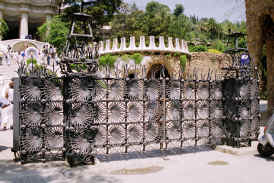
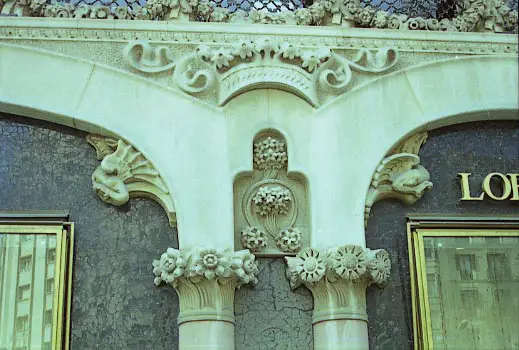
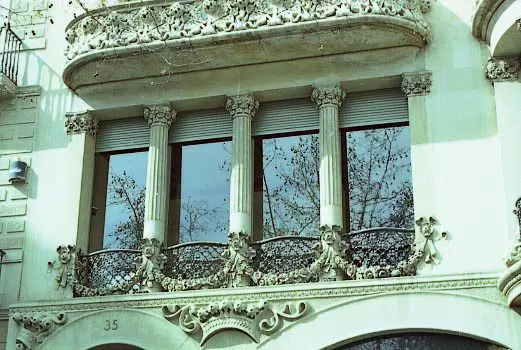
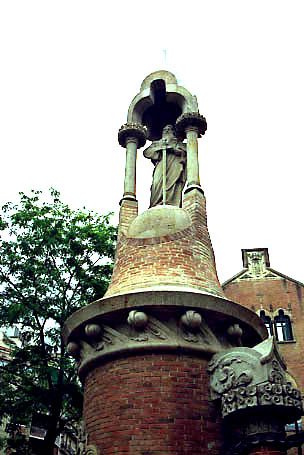
The Catalan Art Nouveau does not only reflect in its architecture the ornamentation richness who is common in all the Art Nouveau, but also manifest an interest to maintain and renew the traditional building and decoration techniques, using old materials such as brick and new materials (at that time) as iron and new ceramic techniques.
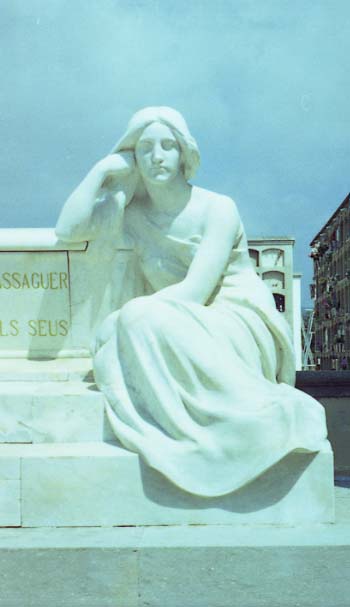
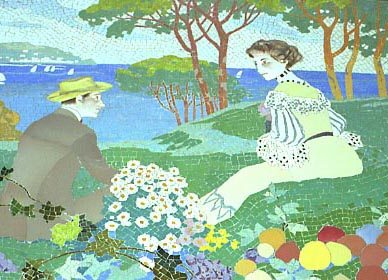
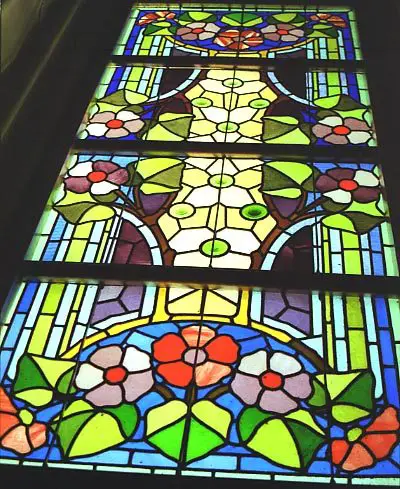
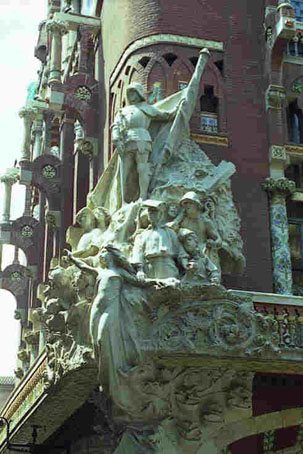
These new tendencies were evident in all the different artistic areas such as architecture (including all types of buildings), sculpture (both as an independent art, or as a complement of buildings), painting, decorative arts (in materials as ceramics, glasses, wood, textiles, iron, and comprising any object as furniture, lamps, jewels, clothes, bottles, pitchers, crockery’s, carpets, etc.), literature and music.
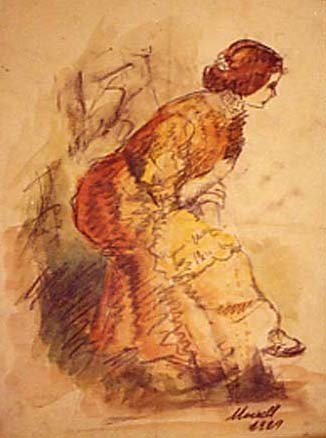
The Art Nouveau had a tremendous social acceptation in Catalonia as part of “Renaixença” and its artists became very popular. That is a fact with the mentioned architects, but also with painters as Ramon Casas, Isidre Nonell or Santiago Rusiñol (organizer of “Festes Modernistes” -Art Nouveau festivals- held in Sitges at the end of XIX century).
Some of these artists – the bohemian side of Art Nouveau – had regular meetings from 1897 in the literary café “Els quatre gats” installed in a building of Puig i Cadafalch in the old Barcelona, an Art Nouveau café with a huge prestige in artistic circles. These meetings were also frequented by other artists as Picasso -his paintings of blue and rose period are considered Art Nouveau-, Miquel Utrillo, Mir, Pichot, and others.
The magazine “Pèl i ploma” published by Ramon Casas was the voice of the movement in Barcelona.
That collective attitude of artistic renewal and progress was the driver of one of most brilliant periods of Catalan art.
See the specific pages on Catalan Art Nouveau Architecture
Sculpture
Painting
Decorative arts
Literature
Music
and also the pages devoted to special aspects of Catalan Art Nouveau as the Wine cathedrals and the Funerary Art Nouveau
Photo Gallery



Bibliography
| Title of the book |
Author | Published by |
Year |
| Arquitectura modernista |
Bohigas, Oriol |
Lumen | 1968 |
| The Art Nouveau Style |
Buffet-Challié, Laurence |
Academy Editions, London |
1982 |
| Art Nouveau |
Champigneulle, Bernard |
Barron’s Educ. Series, Inc. |
1972 |
| Paris and Art Nouveau |
Constantino, Maria |
Editions Atlen |
1990 |
| Gran enciclopèdia catalana |
Different authors |
Enciclopèdia Catalana |
|
| Modernisme i Modernistes |
Different authors |
Lunwerg |
2001 |
| Art Nouveau |
Duncan, Alistair |
World of Art Series, Thames and Hudson |
2000 |
| El modernisme a Catalunya |
Freixa, Mireia | Barcanova |
1991 |
| El Modernismo en España | Freixa, M. | 1990 | |
| Art Nouveau |
Sembach, Klaus-Jurgen |
Taschen | 2000 |
If you find any broken links or other issues, please contact us so we may fix them! Thank you for visiting Gaudi All Gaudi!
http://www.theartstory.org/movement-art-nouveau.htm – Art Nouveau movement from theartstory.org
https://en.wikipedia.org/wiki/Art_Nouveau
We’d like to thank William Hill for supporting GaudiAllGaudi.com. You can learn more about the available William Hill promo codes at https://williamhillpromocode.co.uk
