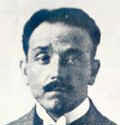
Josep Maria Julol i Gibert (1879-1949)
Works
In Barcelona:
Planells House
Monumental fountain of Spain square
In Constantí:
Baptistery and Presbytery of the Parish Church
In Cornellà:
Can Camprubí
In Creixell:
Tower top of Sant Jaume Church
In Els Pallaresos:
Ca l’Andreu
Bofarull House
Soler House
In Montferri:
Montserrat Shrine
In Renau:
Restoration of the Lloret shrine
In Sant Joan Despí:
Can Negre
Gamisans House -attributed-
Rovira House
S. Joan Baptista Church
Reixat (Grating)
Torre de la Creu (Casa dels ous)
Serra-Xaus Villa
Jujol Villa
In Tarragona:
Abad House
Ximenis House
Metropol Theater
In Vallmoll:
Roser Shrine
In Vistabella (La Secuita):
Sagrat Cor Church
Life
Josep Maria Jujol was born in Tarragona, on 16 September 1879.
In 1883 he went with his family to Gracia (a town close to Barcelona later integrated in the city).
He finished his baccalaureate studies in 1896.
Once his elementary studies were finished, he went to Barcelona to study in the Sciences Faculty and later in the Escola Superior d’Arquitectura de Barcelona from 1901, when Domènech i Montaner was the Director.
He was titled as architect in 1906.
In 1904 he started to work with Gaudí, never stopping his close collaboration with him until the great architect’s death in 1927, and helping him in the construction of La Pedrera, Park Güell and other works.
He was a professor of the Escola Superior d’Arquitectura de Barcelona from 1910. In addition to his work as architect, he also pursued very interesting side-lines as a designer and sculptor (Professor of Barcelona Escola del Treball).
The architectural work of Jujol is modest, not only in the size and characteristics of his commissioned works, but also for their small budgets (especially in comparison with the big Art Nouveau Catalan architects Gaudí, Domènech i Montaner, Puig i Cadafalch, Sagnier and others), but these are no reasons to deny his genius. In fact the contrast between the limitation of his possibilities and the richness and originality of his works is one of the most interesting aspects of Jujol’s output.
The works listed on the left hand side of this page may be regarded as his most important, but they form only a small part of the large quantity of small-scale works that he built in Catalonia, essentially around the Camp de Tarragona region.
Josep Maria Jujol died in Barcelona, on 1 May 1949.
Specific Bibliography |
|||
| Title of book | Author | Published by | Year |
| An introduction and Guide to the Architecture of Jujol |
Lumen Books |
1983 | |
| Jujol | Bassegoda i Nonell, Joan |
Editorial Nou Art Thor |
1990 |
| Jujol, Five Major Buildings |
Dollens, Dennis |
Sites-Lumen Books |
1994 |
| Jujol | Dollens, Dennis and others / Photos: Cuxart, Jordi |
Mº de Fomento / Col.legi d’Arquitectes de Catalunya |
1998 |
| Josep Ma. Jujol a Sant Joan Despí |
Duran i Albareda, Montserrat / Miserachs, Xavier |
Ajuntament de S. Joan Despí / Corporació Metropolitana de Barcelona |
1987 |
| The Architecture of Jujol |
Jujol, Josep Maria (son) |
Sites-Lumen Books |
1996 |
| Josep Maria Jujol arquitecte 1879-1979 |
Solà-Morales. Ignasi and others |
Col.legi d’Arquitectes de Catalunya |
1988 |
| Jujol | Solà-Morales, Ignasi / Photos: Levick, Melva |
Editorial Poligrafa |
1990 |
Other Catalan Art Nouveau Architects
Antoni Gaudí i Cornet
Lluís Domènech i Montaner
Josep Puig i Cadafalch
Antoni Maria Gallissà i Soqué
Josep Maria Jujol i Gibert
Cèsar Martinell i Brunet
Manel Joaquim Raspall i Mallol
Joan Rubió i Bellver
Enric Sagnier i Villavecchia
Salvador Valeri i Pupurull
and others
