
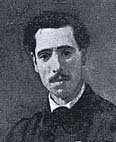
Venanci Vallmitjana i Barbany (1826-1919)
Works
Sculpture:
Evangelists (Together with his brother Agapit
Vallmitjana 1854)
Sant Jordi (Saint George 1861)
Portrait of Lord Stanley and his
wife (1872)
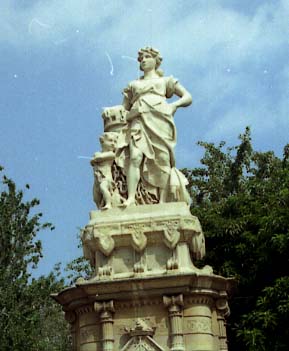
The Agriculture (Ciutadella Park in Barcelona 1886)
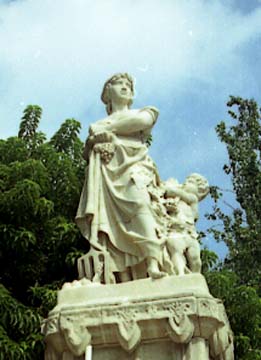
The Marine (Ciutadella Park in Barcelona 1886)
The Tradition (1890)
Alphonse X the Wise (Barcelona University)
Averroes (Barcelona University)
Baby
Bust of Benet Mercadé i Fàbregas (Catalonian Parliament in Barcelona)
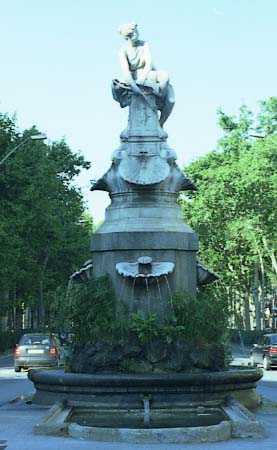
Diana fountain (Gran Via/Llúria in Barcelona)
Fígaro
Lions (2) (Hall of Catalonian Government
Palace)
Lluís Vives (Barcelona University)
Manola
Monastery of Montserrat façade
(Together with his brother Agapit)
Old lady portrait (Barcelona City Hall first floor)
Ramon Llull (Barcelona University)
Saint Isidor (Barcelona University)
Saint Venanci
Sketch for a statue to the queen Maria Cristina
Statue of Antoni López i López –
Marquis of Comillas – (P.Colom /
Via Laietana in Barcelona)
The Muse of music (Gran Teatre del
Liceu – Opera house – in Barcelona)
The Pietá
The Trinity
Virgin standing with the Christ-child
Virgin lifting the Crist-child
Women (2) (Urban Police building in Barcelona – attributed)
Young woman at the source
Funerary sculpture:
Tomb (Arenys de Mar Cemetery)
Life
Born in Barcelona in 1826.
He studied together with his brother Agapit in the School of Llotja in Barcelona, as a disciple of the famous Catalonian sculptor Damià Campeny. Being one of the school’s most brilliant students, he received the prize of Llotja in 1844.
At the outset of his artistic career, he produced small nativity scene figures in clay in the Baroque style in collaboration with his brother Agapit, both of whom worked from an atelier in Tapinería Street in Barcelona.
By 1853, he had produced the statues of the evangelists for the Church of Sant Just in Barcelona, and in 1856, he became a Professor at the School of Llotja. A little later, he executed statues for the facade of the Bank of Barcelona.
Having established his reputation as a sculptor, his atelier in the chapel of Saint Àgata was visited by the most famous personalities of the day, which resulted in him receiving further important commissions .
In 1872, together with its brother Agapit, he travelled to Manchester, England, where they carried out the portraits of Lord and Lady Stanley. They also visited Paris, where their work was also well received in artistic circles.
A significant amount of his mature work was carried out in collaboration with his brother, and it is at times difficult to identify their individual contributions. Nevertheless, it is acknowledged that in Venanci’s work there is a greater sense of the spectacular. However, although it has general thought by historians and commentators that his work is of a higher quality than that of his brother, this opinion is currently being revised as a result of the greater appreciation that is now being given to the more formal perfection that is evident in Agapit’s work.
Although the Vallmitjana brothers should be considered as academic sculptors working in a realistic style, and therefore predating modernism (Catalan Art Nouveau), because the majority of their work was carried out before this style emerged, the fact that both were teachers of famous modernist sculptors, such as Llimona, Gargallo and others, gives them a special importance as precursors of the style.
After the death of his younger brother Agapit in 1905, which broke the fertile bond that ensured their collaborative success, Venanci Vallitjana i Barbany continued to live and work in Barcelona until his death in 1919.
Images
Left to Right:
The Marine 1886
The Agriculture 1886
Diana
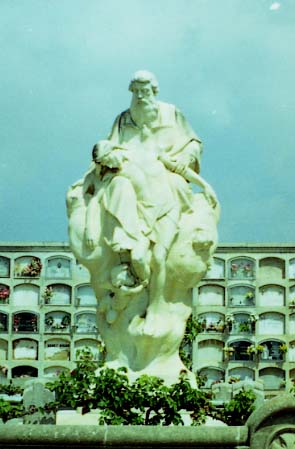
Funerary Sculpture
Pantheón in Arenys de Mar Cemetery
| Title | Author | Published by | Year |
|
Guía del Cementerio de Montjuïc |
Aguado, Neus |
Institut Municipal dels Serveis Funeraris de Barcelona |
1993 |
| L’escultura catalana | Cirici i Pellicer | 1957 | |
| gran enciclopèdia catalana | Different authors | Enciclopèdia Catalana | |
| Enciclopèdia Salvat Català | Different authors | Edicions Salvat | |
| Un siglo de escultura catalana | Infiesta,José Manuel | 1975 | |
| Diccionario bibliográfico de artistas de Cataluña | Ràfols, J. F. | 1953 | |
| L’escultura del segle XIX a Catalunya | Subirachs i Burgaya, Judit | Publicacions de l’Abadia de Montserrat | 1994 |
Catàleg de donatius |
Junta de Museus de Catalunya |
|
|
Other Catalan Art Nouveau Sculptors
Eusebi ARNAU i Mascort
Miquel BLAY i Fabregues
Joan Carreres
Enric Clarasó i Daudí
Lambert Escaler i Milà
Manel FUXÀ i Leal
Pau GARGALLO i Catalán
Alfons Juyol i Bach
Josep LLIMONA i Bruguera
Agustí Querol
Josep Reynés i Gurguí
Agapit VALLMITJANA i Barbany
VenancI VALLMITJANA i Barbany
