
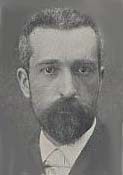
Works
In Catalonia:
In Barcelona:
L’ Escolà – The altar boy – (1870)
The death of the just one (1876)
The sign of the cross (1881)
Neptune (Ciutadella Park-Waterfall 1881)
Leda (Ciutadella Park-Waterfall 1881)
Saint Francisco of Assísi (1892)
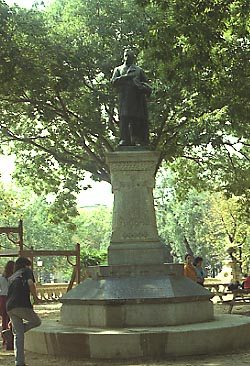
Aribau (Ciutadella Park 1884)
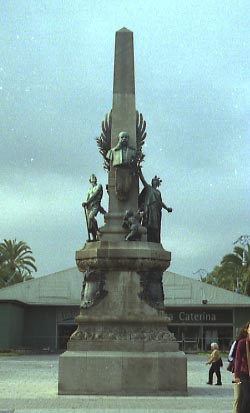
Clavé (Sant Joan Promenade 1888)
Bernat Desclot (vanished Statue 1888)
Rius i Taulet (Lluís Companys Promenade)
Fra Bernat Boïl (Monument to Columbus – Porta de la Pau -Gate of Peace- 1888)
Law Courts (Passeig Ll. Companys)
(3 relief’s) :
The Catalonia statutes
The “Consulat del Mar” (Sea laws
of Barcelona)
Placement of the 1st stone of the
Palace
(4 of the 48 sculptures) :
Josep Finestres
Pablo de Castro
José Moñino
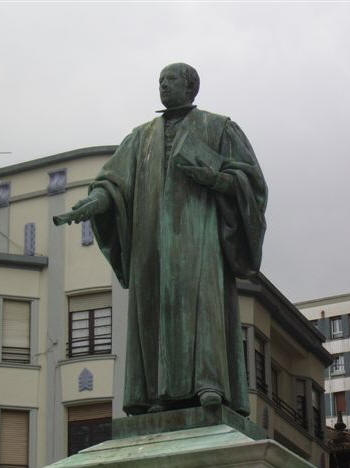
Gaspar Melchor de Jovellanos
Various Works in the Monastery of Pompeia (Diagonal Av./Riera S. Miquel)
Estalvi – Savings – (La Caixa – Via Laietana)
Post Office (Via Laietana/ P. Colom)
(4 statues) :
The Navy
The Science
The Telegraph
The Mail
Sant Jaume – Saint James – (Caixa Provincial -Plaza Sant Jaume)
Jaume I – James the I A Catalan king – (City Hall Barcelona – Lounge of Cent)
Sant Jordi – Saint George – (City Hall Barcelona – Lounge of Cent)
Bust of Víctor Balaguer (Ciutadella Park 1910)
Bust of Manuel Milà i Fontanals (Ciutadella Park)
Bust of Pere Pau Muntanyà (Parliament 1915)
Bust of Elies Rogent (Parliament)
Bust of Marcelino Menendez Pelayo
Bust of Pepita Teixidor i Torres (Ciutadella Park 1917)
Bust of Joaquim Vayreda (Ciutadella Park)
Bust of Joaquim Vayreda (Parliament)
Bust of Manuel Planas i Casals
(Diputació – Country Council Offices)
Bust of Jacint Verdaguer
(Ateneu Barcelonés – Barcelona literary Society)
Neptune (Espanya Industrial Park)
The Agriculture (Diagonal Av./ T.C.
Valenzuela Street)
In Sabadell:
Monument to Pere Turull (Caixa of Sabadell – Sabadell Savings Bank)
In Vilanova i the Geltrú:
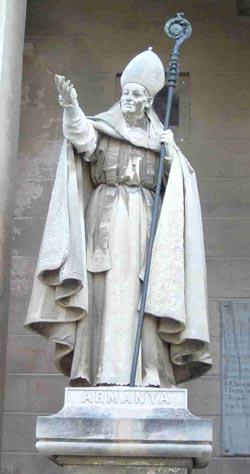
Bishop Armanyà (Francesc Armanyà i Source – V. Balaguer Museum)
Funerary sculpture:
Albareda Tomb (Southwest Cemetery in Barcelona)
Batllo Batllo Tomb (Southwest Cemetery in Barcelona 1889)
Cazes-Clavell Tomb (Southwest Cemetery in Barcelona 1897 – in contribution with Reynés)
Carreras Tomb (Cemetery of Sitges)
Out of Catalonia:
Lope de Vega (Façade of the National Library Madrid – Spain)
Benito Jerónimo de Feijóo (Ourense – Galícia – Spain)
Melchor Gaspar de Jovellanos (Gijón – Spain)
Life
Born in Barcelona in 1850, he initially trained in the school of Llotja in Barcelona with the master Rosend Nobas, and also worked as apprentice in the studio of Joan Roig i Soler.
Fuxà subsequently studied in Paris, where he worked in the studio of Albert-Ernest Carrier-Belleuse, seeking artistic improvement and acquiring a greater control of technique. He also spent time in Italy.
After his return to Barcelona, at the age of 26 in 1876, he was named Reader in the same school of Llotja where he initially studied, and later became its director between 1911 and 1920.
Fuxà was also appointed as the President of the Barcelona Museums Council.
His artistic output was prodigious; according to Felix Mestres i Borrell he was the most prolific sculptor of this period. He produced many public monuments in Barcelona, as well as in other cities and towns in Catalonia, including Alella, Figueres, Mataró, Reus, Sabadell, Sant Feliu de Guíxols, Vilafranca del Penedès, Vilanova i la Geltrú and Sitges, and received commissions for work in cities outwith Catalonia, such as Gijón, Madrid, Montevideo and Ourense.
He also executed funerary monuments for cemeteries in Barcelona and Sitges, portrait busts, and sculpture for buildings. Although the latter was conventional in style, it was nevertheless always of the highest artistic quality, Fuxà was perhaps an impersonal artist, but at the same time an excellent executor capable of carrying out a great quantity of assignments.
His style cannot be classified strictly within the Modernisme (Catalan Art Nouveau) idiom because his work is much more classical in feeling, following the school of the brothers Venanci and Agapit Vallmitjana, but the influences of Modernism cannot be denied – Felix Elies relates him to the Overbeck school and Pubis de Chavannes – especially in the middle and latter periods of his career.
Some of the monuments he produced were probably developed in collaboration with other artists, such as the architect Pere Falqués i Urpí – Monument to Rius i Taulet – and Josep Vilaseca i Casanovas (1848-1910), who was also a premodernista (previous to Catalan Art Nouveau) sculptor – Monuments to Aribau and Clavé.
Fuxà’s work is related to the Renaixença (a period with a strong cultural development in Catalonia) and he therefore contributed to the recovery of the Catalonian identity.
Manel Fuxà died in Barcelona in the year 1927.
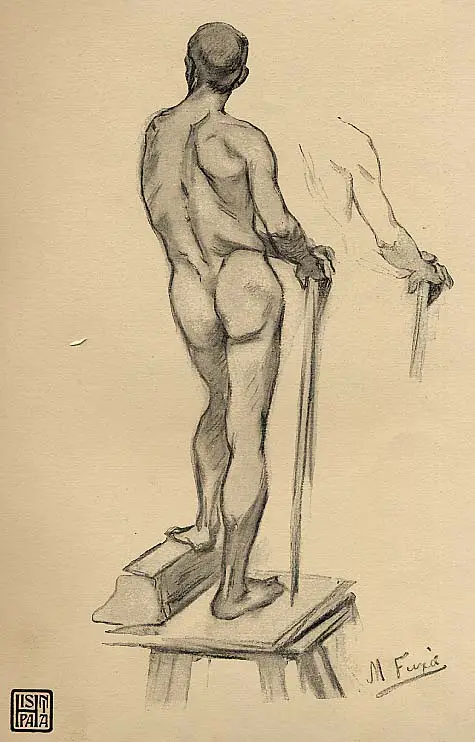
Images
Left to Right – Top Row:
Bonaventura C. Aribau – 1884 Ciutadella Park
Francesc Rius i Taulet – 1901 Ll. Companys Promenade
The Bishop Armanyà – Vilanova i la Geltrú
Joaquim Vayreda i Vila – 1915 Ciutadella Park
Left to Right – Bottom Row:
Manel Milà i Fontanals – 1908 Ciutadella Park
Pepita Teixidó – 1917 Ciutadella Park
Víctor Balaguer – 1910 Ciutadella Park
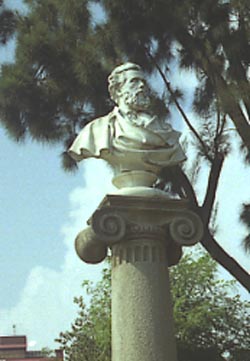
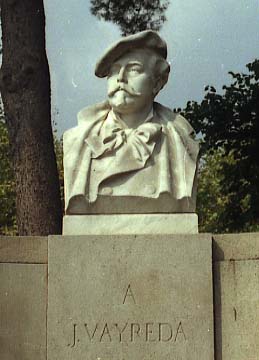
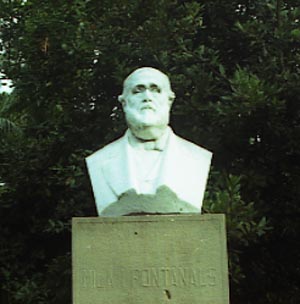
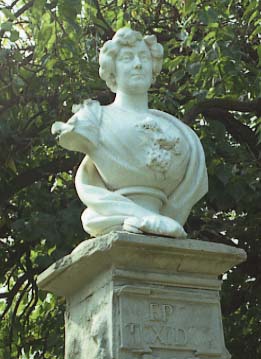
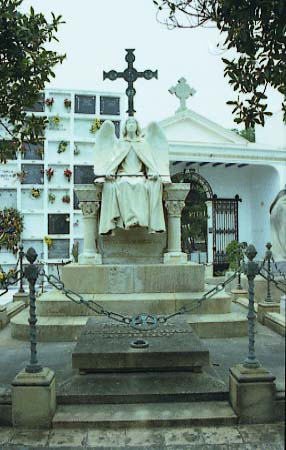
Funerary Sculpture
Carreras Tomb – 1907 Sitges Cemetery
Out of Catalonia
Gaspar Melchor de Jovellanos, Gijón – Spain
Source: www.esculturaurbana.com
Specific Bibliography |
|||
| Title | Author | Published by |
Year |
|
Guía del Cementerio de Montjuïc |
Aguado, Neus |
Institut Municipal dels Serveis |
1993 |
| L’escultura catalana | Cirici i Pellicer | 1957 | |
| Gran Enciclopèdia Catalana |
Different authors | Enciclopèdia Catalana | |
| Enciclopèdia Salvat Català | Different authors |
Edicions Salvat | |
| Un siglo de escultura catalana | Infiesta, José Manuel | 1975 | |
| Diccionario bibliográfico de artistas de Cataluña |
Ràfols, J. F. | 1953 | |
| L’escultura del segle XIX a Catalunya | Subirachs i Burgaya, Judit | Publicacions de l’Abadia de Montserrat |
1994 |
Other Catalan Art Nouveau Sculptors
Eusebi ARNAU i Mascort
Miquel BLAY i Fabregues
Joan Carreres
Enric Clarasó i Daudí
Lambert Escaler i Milà
Manel FUXÀ i Leal
Pau GARGALLO i Catalán
Alfons Juyol i Bach
Josep LLIMONA i Bruguera
Agustí Querol
Josep Reynés i Gurguí
Agapit VALLMITJANA i Barbany
VenancI VALLMITJANA i Barbany
