
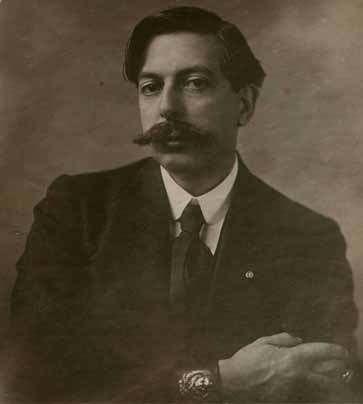
Enric Granados i Campina (1867-1916)
Work:
Piano music:
-Clotilde (mazurca)
-Elvira (mazurca)
-A la antigua (bourrée)
-Carta d’amor (Letter of love)
-Valsos poètics (Poetic waltzes)
-Carezza (Caress – waltz)
-Valse de concert (Concert waltz)
-Exquise (Exquise gypsy waltz)
-Minuetto de la felicidad (Happiness Minuet)
-El amor de la Virgen (Virgin love)
-Impressions de viatge (Travel impressions)
-Seis marchas militares (Six Military marches – two of it for four hands)
-Rapsodia aragonesa (Aragonese Rapsody)
-Capricho español (Spanish Caprice)
-A la cubana (Cuban style)
-Moresca (Morish)
-Danza lenta (Slow dance)
-Jácara (dance)
-En la aldea (In the hamlet – eight pieces for four hands)
-Danza gitana (Gypsy dance)
-Canción y danza (Song and dance)
-Danzas para cantar y bailar (Dances to sing and dance)
-Doce danzas españolas (Twelve Spanish dances – 1890 – For piano, three of it orchestrated by Joan Lamote de Grignon):
•Galante (Galant)
•Orientale (Orientale)
•Fandango (Fandango)
•Villanesca (Rustic)
•Andaluza (Andalusian)
•Rondalla aragonesa (Aragonese rondalla)
•Valenciana (Valencian)
•Sardana (Typical Catalan dance)
•Romántica (Romantic)
•Melancólica (Melancholy)
•Arabesca (Arabesque)
•Bolero (Bolero)
-Seis piezas sobre cantos populares españoles (Six pieces on Spanish popular songs)
-Escenas románticas (Romantic scenes – 1903 – eight pieces):
•Mazurca (Mazurca)
•Berceuse
•Alegretto
•Mazurca
•Allegro appassionato
•Epílogo (Epilogue)
-Escenas poéticas (Poetic scenes – two series)
-Libro de horas
-Bocetos (Sketches) – 1912):
•Despertar del cazador (The wake up of the fighter)
•El hada y el niño (The good fairy and the baby)
•Vals muy lento (Very slow waltz)
•La campana de la tarde (The afternoon bell)
-Cuentos de la juventud (Youth tales)
-Escenas infantiles (Child scenes)
-Allegro de concierto (Allegro of concert – 1903)
-Allegro apassionato
-Fantasia (Fantasy)
-Paisaje (Landscape)
-Romeo y Julieta (Romeo and Juliet)
-Goyescas (1911 – Suite for piano – six pieces lately orchestred):
•Los requiebros (The compliments)
•Coloquio en la reja (Dialog at bars)
•Duo de amor (Love duet)
•Quejas o La maja y el ruiseñor (The “maja” and the nightingale)
•El amor y la muerte (Love and death – ballad)
•Epílogo, serenata del espectro (Epilogue, the serenade of the spectre)
-Obras fáciles para la educación del sentimiento (Simple works for the sentimental education)
-Seis estudios expresivos en forma de piezas fáciles (Six expressive studies as simple pieces)
-Dos impromptus (Two impromptus)
-Impromptu y barcarola (Impromptu and barcarolle)
-El pelele (The puppet)
-A la pradera (To the meadow)
-El crepúsculo (The crepuscule)
-Ni así la distingue
-El tango de los ojos verdes (The tango of green eyes)
Chamber music:
-Sonata for violin and piano
-Sonata per a violoncello and piano
-Trio for piano, violin and violoncello
-Quartet for two violins, viola and violoncello
-Romance (string quartet)
-Serenade (two violins and piano)
-Quintet for piano and string
-Andante (violin and piano)
-First romance (violin and piano)
-Madrigal (violoncello and piano)
-Trova (violoncello and piano)
-Oriental (oboe and string)
-Religious scene (violin, organ, piano and kettledrum)
-Three preludes
Music for orchestra:
-Dante o La Divina Comedia (Dant or the Divine comedy – 1908 – symphonic poem)
-La nit del mort (The night of the death – 1912 – suite)
-Elisenda (1912 – suite)
-Navidad (Christmas)
-Suite oriental (Oriental suite)
-Suite sobre cantos gallegos (Suite on Galician religious songs – five time movements)
-Llegenda de la fada (The legend of the goodfairy)
-Marcha de los vencidos (The defeated march)
-Torrijos
-Danza gitana (Gypsy dance)
-Serenata (Serenade)
-Sketches of two concerts and a symphony
-Goyescas interlude (1916 – last work)
Vocal music:
-Canciones amatorias (Love songs)
•Mañanica era (It was Morning)
•Mira que soy niña (Look that i am a baby)
•Gracia mía (My Grace)
•Iban al pinar (They came to the pine grove)
•No lloráis ojuelos (Eyes, don’t cry)
-Tonadillas (Little tunes – 1910):
•Amor y odio (Love and hatred)
•Callejeo (Stroll around)
•El majo discreto (The discreet “majo”)
•El majo tímido (The timid “majo”)
•El mirar de la maja (The watch of the “maja”)
•El tra-la-la y el punteado (The tra-la-la and the picking)
•La maja de Goya (The Goya “maja”)
•La Maja Dolorosa I, II, III (The “maja” Dolorosa I, II, III)
•Ay majo de mi vida! (Oh! the “majo” of my life)
•Oh muerte cruel (Oh! cruel death)
•De aquel majo amante (From this loving “majo”)
•Las currutacas modestas (The modest showiers)
•Si al retiro me llevas (If you give me to retirement)
•El majo olvidado (The forgetted “majo”)
-Boires baixes (Low fogs)
-L’ocell profeta (The bird prophet – text: Countess of Castellà)
-Elegia eterna i Lo rey y’l juglar (Eternal elegy and The king and the minstrel – text: Apel·les Mestres)
-Cançoneta (Small song)
-Canción del pestillón (Latch song)
-Cançó de Janer (January song)
-Cant de les estrelles (Stars song – chorus, organ and piano)
Stage music:
-Maria del Carmen (1898 – Opera – text: Josep Feliu i Codina)
-Goyescas (1916 – Opera – text: F. Periquet)
-Ovillejos
-Miel de la Alcarria (Alcarria honey)
-Blancaflor (text: Adrià Gual)
-Petrarca
-Picarol (1901)
-Follet (1903)
-Gaziel (1906)
-Liliana, (1911 – text: Apel·les Mestres)
Biography:
First years:
Enrique Granados was born in Lleida on July 27, 1867 to Calixto Granados and Enriqueta Campiña. His father was an army captain of Cuban descent and, shortly after Enrique was born, was nominated to be military governor of Santa Cruz de Tenerife in the Canary Islands. Therefore the first environment of the future maestro (as he would recall many years later) was a little garden of orange and lemon trees that he could see and whose flowers he could smell from the window of his house. He liked to say of those first years that it was like living in paradise itself.
In 1874, when Enrique was only seven years old, his father suffered a fall from his horse during cavalcade, and as a consequence the family had to move to Barcelona. His parents noticed that their boy reacted in a special way when he heard music and enjoyed it unusually much for a person of his age.One of Enrique’s father’s friends was Captain Josep Junceda, who, upon being told of Enrique’s special musical sensitivities, offered to give him his first music theory lessons. The boy progressed rapidly, and soon it was obvious the family needed to move near a piano instructor to develop the young Granados’ innate musical ability. He then enrolled in the Escolonia de la Mercé, where the master Francesc Xavier Jurnet taught classes. After a very short while, Jurnet was confounded by the advances his pupil had made under his tutelage, during which Jurnet had taught Granados absolutely everything he knew.
Perhaps the recent death of his father (which desolated Granados in no small way) awakened in him a sense of responsibility – he was now one of the heads of a large family – and stimulated him to give all that he could of himself. Consequently, Granados would study up to ten hours a day, with his mother at his side, reviewing over and over again all the piano pieces that Jurnet had been able to teach him.He also often performed for his friends and acquaintances who visited him in order to hear the “child prodigy,” as a young pianist named Picó (who attended these private concerts assiduously) had nicknamed Granados. It was Picó who spoke to Enrique’s mother of the qualities that he saw in young Granados and who made her see the great necessity of going to visit Pujol, the master.
The Pujol Academy:
At that time, Joan Baptista Pujol was considered the best piano instructor in all of Barcelona. His pupils included (among others) Albéniz, Malats, and Vidiella. Over time, profound friendship and mutual admiration took root among those three and Granados. The “Pujol Academy” was the forge of Catalan pianists, and there Granados and his mother presented themselves one fine day to see the director. The director asked Granados to play something. Though it is not known what young Granados chose to play, he must have played it quite well, because he did not have to beg for admission any longer; Pujol immediately agreed to take Granados under his wing.
Teacher and student developed a total mind meld. Granados learned everything, and with a keenness and innate ability that did not pass unnoticed by Pujol. Pujol immediately thought about presenting his most advanced student in one of the famous competitions for young pianists held by the academy – one of those rights of passage for young prodigies. He told his pupil to learn Schumann’s Sonata in g minor, to which Granados dedicated himself heart and soul. It was 1882, and Granados was fifteen years old when he debuted in the competition. It could not have ended otherwise: Granados was awarded first prize.As he would say years later, that Schumann sonata was the first “decent” work that he had ever played.
Working to Survive:
In order to help his family, Granados found a position as pianist in the “Café de las delícies” (later the Golden Lion), entertaining patrons with music, something quite fashionable in elegant locales around Barcelona.
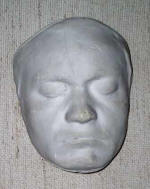
He earned 100 pesetas per month. All went to supporting the ten siblings and cousins under his mother’s care. Granados also worked for the Café Filipion on Carrer Hospital, where he had to accompany patrons who would spontaneously get up to sing or to play various instruments (violin, trumpet, etc.).
Later on, Granados gave music lessons to the children of Eduard Conde, owner of the El Siglo department stores, thanks to the intervention both of his sister Zoe (who knitted for him) and the Schumann Sonata in g minor, which he played to prove himself to Sr. Conde; needless to say, the businessman was impressed by the young master’s genius.
In the midst of all this, Granados wrote his first compositions. His famous Twelve Spanish Dances date from 1883—a fact Granados liked to emphasize years later when they finally became known to the public.That same year was one of transcendental importance for Granados’ career as a composer: he deepened his musical knowledge at the hand of Felip Pedrell, the most important contemporary musicologist and pedagogue in Catalonia. Finally, the great master found that something inside him was consciously crying out for fame and realized that an awaiting audience could be found for him in every musical outlet.
The Parisian Years:
Sr. Conde was, at the very least, a megalomaniac who recognized the value of Granados from the very first, self-proclaiming his unconditional patronage, and thought that he needed to spend some time in Paris, as it was unforgivable at that time not to be at the heart of all musical innovation.Conde took it upon himself to take Granados
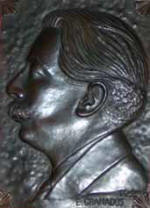
In Paris at the same time was Ricard Viñes, the great pianist and former classmate of Granados at the Pujol Academy, also from Lleida. They shared rooms for a large part of their stay at the Hotel of Cologne and Spain. Thanks to Viñes we know many anecdotes about that time. Another inseparable companion of that period was Malats, and none of the three forgot the lessons of Charles de Bériot, whom they followed with true fanaticism. But later, like a good youth, Granados made all the merriment that he could. The writings of Viñes bear witness that those times in Paris were the happiest of the three young men’s lives.
Conservatory students auditioned at the Salle Erard, and there Granados and Viñes played together publicly for the first time—piano duets, along with music by Chopin, Schumann, Grieg, and Bizet. Despite having to study many hours a day, they also frequented the Concerts Lamoreux and the Comèdie Française, and pedaled throughout Paris on a ridiculous rented tricycle.
Granados was also an aficionado of painting, and on weekends he dined at the house of Francesc Miralles, already a dear friend and childhood neighbor from La Rambla de Catalunya), where he snooped around the paintings and easels. Later on in life, these lazy afternoons would serve as ideas for some his musical sketches.
This era ended in July 1889.Granados had learned certainly in this period all that he needed to know musically to be able to finish developing his personality, which already at that time dispensed with limitations and made him creator of works of great breadth and scope that came to be known by a wide public.
Upon his return to Barcelona, Granados was already equally a great pianist a great composer.
The Granados-Gal Family:
Professionally, Granados gave a concert at the Teatro Lírico on April 19, 1890, the first in an important series of recitals that made him known in the city. He then embarked on a tour of several cities in Catalunya, as well as Madrid. But soon a special twist came into his life:Empar Gal Llobera, the daughter of a minor industrialist. Granados lost no time, and in June 1893 the two married in the Església de la Mercè in Barcelona. The following July, their first child was born, whom they named Eduard in honor of Granados’s benefactor, Sr. Conde.Later came more: Solita, Enric, Víctor, Natàlia, and Paquito—the last born in 1901. It was a group whom Granados loved deeply.
Now he had to integrate his family life with his professional life.The families always tied most closely to Granados were the Condes, the Mirós, the Pi i Sunyers, and the Andreus, who were his second greatest patrons. The daughters of the Andreu family—Carme, Madronita, and Paquita—were gifted piano students.Granados dedicated a large part of his time to composition and to his family and went a long period without giving concerts.
During this time he worked on the opera Maria del Carmen (premiered at the Teatro Circo de Parish in Madrid in 1898), the Serenade for Two Violins,a Trio for Violin, Cello, and Piano, Carta d’amor (Love Letter, dedicated to Empar), and
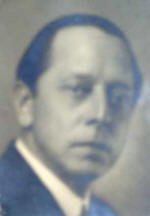
the suite Poetic Waltzes, dedicated to Joaquim Malats.
In order to create his most popular work of this period, the piano suite Goyescas, he first glanced back at pieces inspired by Goya and his era. In light of the suite’s universal success, his friend Ernest Schelling suggested that Granados write an operatic version, but it would not be completed until 1913, when the master was at the highest peak of his fame.For a long time, Granados lived his family life and composed – spending less of his time giving concerts.
He returned again to the public in November 1895, when he played Albéniz’s Spanish Rhapsody at a particularly regionalist concert, more than memorable for the huge number of notable personalities who attended. Among them were Albéniz, Nicolau, and Morera. Granados confirmed himself as a master at this concert. Between 1896 and 1897 he performed sonatas with the Belgian violinist Mathieu Crickboom and became part of the quartet of the same name, founded by the violinist.Granados and Casals were the first virtuosos invited to join.
In 1899, Granados founded the Society of Classical Concerts.The intense activity set him back for a season and kept him from completing some qualification exams for a professorship at the Madrid Conservatory.
Granados as Teacher:
In 1901, Granados created the Granados Academy, first on Carrer Fontanella and later on the
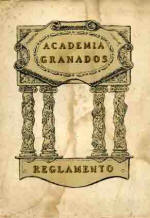
corner of Carrers Girona and Casp.This event disgusted Crickboom, since Granados began to spend more time teaching than in collaboration with Crickboom’s quartet.The school’s philosophies included paying attention from the very first day to the position of the arm, the wrist, and the fingers; giving special consideration to use of the pedal (which gave rise to the didactic treatise “Practical Theoretical Method for the Use of the Piano Pedals”); avoiding the development of even the most minor vice; and, if the student transferred in from another school, getting off on the right foot from the beginning.Granados made his disciples repeat Bériot’s Exercises for Five Fingers ad nauseam, since he considered them an ideal warm-up; he himself said that he always practiced them before playing.
A very sensible man, he taught patiently, trying not to antagonize his students – too pleasant toward them, according to Boladeres. More than once, in the middle of a lesson, Granados begged a student to excuse him while he jotted down an idea or a passage that in that very moment had popped into his head, or even while he played a passage himself. These interruptions soon became widely known, even internationally, where Granados was highly esteemed as a teacher. Henri Collet in Les Maitres de la Musique had this to say: “The dual talent of Granados to teach both virtuosity and composition grew larger and larger and developed in such a way that it became the crowning feature of a truly international
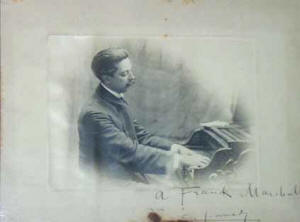
reputation.”A number of artists graduated from his Academy, including the likes of Mercè Moner, Anna March, Paquita Madriguera (who later married Andrés Segovia), Ferran Via, Franck
Marshall, Juli Pons, Baltasar Samper, Ricard Vives, Josep and Empar Iturbi, Josep Caminals, and a host of others.
Even with the premature death of Granados in 1916, the Academy neither closed nor slowed down. Granados’ son, Eduard, headed the school for only three years before he succumbed to typhoid fever at the age of 34.Franck Marshall successfully assumed the director’s position, and at that time it came to be known as the Marshall Academy, as it is known today.Marshall knew perfectly well how to transmit the same knowledge that Granados would have.Names like Alicia de Larrocha, Rosa Sabater, María Vilardell, Carlota Garriga, Joan Torra, and many others have drunk from the fountain the master opened. From the Granados Academy emerged what was later known as the Granados School; therefore because of the techniques and theresolutions that were taught it can be said that – together with Isaac Albéniz – Granados was the founder of the modern Catalan school of piano.
The Fullness of Life:
The musical activity of Granados coincided with the triumph of Catalan modernisme. His refined harmony was at the service of a romantic aesthetic influenced by Schumann and Liszt.His music was impregnated with an aristocratic air and a smooth, unbridled elegance.Interpreting the piano he was restrained, without the slightest bit of arrogance in either gesture or figure, far from affectations, without unnecessary swinging over the keyboard, but rather with straight and serious posture with his head
erect.His personal sensibilities translated to his behavior at the piano.Various opinions on his personality are located at the bottom of this page.
His friend and patron, Doctor Andreu, financed a concert hall in 1912 at Avinguda del Tibidabo 18, where Granados ensured that his pupils had their first contact with the public.Among his students was Conxita Badia, a young girl who at first studied piano with great difficulty, but in whom Granados discovered an extraordinary gift for singing.He considered it inevitable that she would
abandon the piano and dedicate herself exclusively to voice; it would be unforgivable to keep her from it.The girl took her master seriously and began to develop an extraordinary musical career.
On April 1, 1911, Goyescas premiered to great acclaim at the Salle Pleyel in Paris.At that time, it was still a suite
for piano.Mr. Pleyel asked Granados to repeat the concert four days later, again with great success.Enchanted, he gave him the grand piano on which he had played the two concerts.That piano is today preserved at the Generalitat de Catalunya’s Center for Muscial Documentation.
From that moment Goyescas garnered special attention in musical circles.Joaquim Malats, Alfred Cortot, Edouard Risler, and other artists mentioned it in their correspondence. In a letter to Joaquim Malats, Granados declared: “Goyescas is the payment for all my efforts to arrive; they say that I have arrived.In
Goyescas, I have found my whole personality; I fell in love with the psychology of Goya and his palette through his lady maja; his aristocratic majo, him and the Duchess of Alba; his lovers’ quarrels, his loves, his flirtations.That pale blush on his cheeks, contrasting with the blondes and the black velvet with elegant clasps . . . those trembling, corseted bodies, mother-of-pearl and crimson hands folded over jet black; they have transformed me, Joaquín. At last you will see if my music brings out the color
of it.”
A while later Ernest Schelling suggested to Granados that he stage the work.Everything finally got ironed out after Granados thought through the idea and decided to do it, orchestrating it immediately. At the same time, he charged Fernando Periquet – his old collaborator on the text for the songs in Tonadillas – with writing the libretto.
We know that the work was orchestrated somewhere between Barcelona and Vilassar de Mar, in a rented house and was finished by the end of 1913.With all the necessary things in place, the work was set to premiere at the Paris Opera House in early 1915, as director M. Jacques Roucher confirmed in a letter dated June 22, 1914.The wheels were in motion for what would have been Granados’ international baptism.
The Premiere of Goyescas, the Great War, and Its Consequences:
But the European war broke out the same year, causing enormous repercussions for the plans of many people, including those for the premiere of Goyescas, which could no longer be in Paris as planned.Schelling moved quickly and searched for the opportune moment and the right people, as he himself had a vested interest in the work’s success, and closed a deal for the Metropolitan Opera House in New York to include the work in its 1915-1916 season.In New York, Schelling ran into Pau Casals, whom he had asked to be there ahead of time to rehearse with the orchestra. Schelling waited out the change in plans nervously, since it was not the best time to be at sea.“On this voyage I will lose my skin,” he joked.
Finally, Granados and Empar weighed anchor from Barcelona in November 1915 on the Montevideo; the
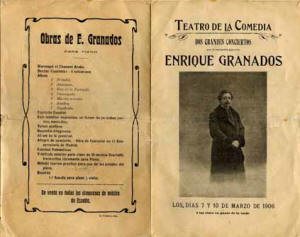
guitarist Miguel Llovet was sailing on the same vessel, which allowed them to make the crossing slightly more entertaining by sharing stories of Barcelona.They left from Cadiz and on November 30 entered the high seas. From a letter Granados wrote to his children upon arriving in New York, we know a French war cruiser, the Cassard, stopped their ship. The incident proved unimportant, but it certainly unsettled the passengers.Once over his nervousness, Granados exclaimed with his proverbial sense of humor, “If we get stopped again, I’m getting off!” In the same letter, he described the voyage: “we have been at sea for ten days, and it takes fifteen. Some calm hours and the rest never-ending storms. We think we will not see you again.One afternoon, your mother and I held each other and prayed that God guide you. . .” They arrived in New York on December 15.
The orchestra rehearsals began quickly, which Pau Casals had already been conducting as planned.Before the premiere, on January 23, Granados gave a concert with the famous cellist at the Friends of Music society.He found time to engrave new pianola rolls for the Aeolian company in addition to fulfilling all his social and musical obligations.Having a European artist in North America at that time was a luxury, and they showered him with flattering compliments.A few days before the premiere the impresario realized the worked lacked an interlude and told Granados.In one night, the composer wrote what would be his last work, and one of his most famous, but it did not satisfy him.He told Casals, “I have written a thing of bad faith, a vulgar thing, a common thing. I’ve created a jota!” Casals’s response calmed him: “Perfect,” he said.“Wasn’t Goya from Aragon?” Joan Alavedra wrote later, “each time that
Casals played that interlude, that sad sigh that began the work, it seemed that he was saying ‘Good-bye’ to his friend.”
The long-awaited day of the premiere arrived.Gaetano Bavagnoli conducted the orchestra, Giulio Setti directed the choir, and Antonio Rovescalli oversaw the costumes and decorations. Applause prolonged the night, but the next day part of the criticism was directed at Rovescalli, accusing him of being presumptuous and devaluing the work, which they said was more symphonic poem than opera, “with a more or less happy vocal part, adapted from a poor libretto.” Others spoke of “energy, of the poetry, the mysterious charm, the richness and the color, the movement, the skill of the polyphonic composition, the stridencies . . .” In the end, Goyescas was performed only five times.Economically, this result was catastrophic, but that did not detract from Granados’ skill as an artist: President Wilson invited him to the White House.
To honor the invitation, Granados and his wife were obligated to change their passage back to Europe.In the hurry to see their children, whom they had not seen for three months, they booked passage on two separate vessels: the S.S. Rotterdam out of Holland to get them as far as Falmouth, England, and the
Sussex out of England to get them from Folkestone to Dieppe, France.On March 7, Granados gave the concert at the White House and later attended a dinner at the Spanish Embassy.There Ambassador Joan Riaño impressed upon Granados the dangers of returning on a British – and therefore belligerent – vessel.Attempts were made to change his tickets, but it was too late, and shortly thereafter, on March 11, the Granados couple departed from New York.
The farewell before boarding was impressive. Many friends and ar
tists were there, among them Schelling, Kreisler, and Paderewski.They presented him with a commemorative silver cup to mark the occasion on which were engraved all their signatures and a passage from Goyescas, with four thousand dollars inside.They arrived in Falmouth on the 19th and visited London. On the 24th, they left from Folkestone on the Sussex, owned by the French Railroad Company, at 1:15pm. In a tragic twist of fate – or destiny – two hours later, the ship was torpedoed by a German submarine.
According to what can be read in the June 1916 Boletín de información para España y América del Sur, the ship’s clocks stopped at 2:50pm, which must have been the time of the catastrophe.The ship was split down the middle, and the front part rapidly sank while the rear part stayed erect; it later was towed to shore in Boulogne.Survivors verified all this.
About twenty lives were lost, among them Granados and Empar, whose bodies were never found. In the part salvaged half of the ship was the couple’s cabin, with all their luggage.Perhaps if they had been in their cabin at that moment,
things would have turned out differently.
Joan Alavedra explained that of all the memorials left to Granados, the most emotional one was the one Pau Casals organized at the Metropolitan in New York, where Granados had bid farewell to his public only days before. Performing with him were Kreisler, Paderewski, Maria Barrientos, Julia Culp, and the tenor McCormack.As a farewell, with great respect and with everyone a standing,
Paderewski played Chopin’s Marche fúnebre, with all the theatre lights extinguished except for a candelabra near the piano. Granados died only a few months before celebrating his 49th birthday.His great friend Albéniz had died only a few years earlier.
Comments on the Life and Work of Granados:
Ricard Viñes, classmate and great friend: “Enric’s character was one of optimism and a happiness that suddenly infected those around him, given his jokes and strong laughter.”
Joan Alavedra: “I have always believed that Granados was a happy man. And I’m not referring to the successes that he had . . . but rather to the feelings that allowed him an exceptional receptivity which he
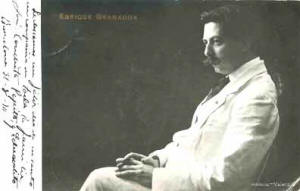
immediately translated into in music. . . it flowed naturally from him . . . with his great sleepy eyes, he passed through the streets listening to music until suddenly he had to stop and write a few measures on the white cuffs of his sleeves.”
His teacher, Felip Pedrell, in La Vanguardia: “Our lessons had little of lessons in them; they were conversations, or rather, chatter among friends with more humor than advice.I felt that when we spoke of slightly complicated technical problems, something very he would close up and become withdrawn; and in recognizing that dry, cold rules had no place in his intellect, I decided never again to speak with
him of rules, resolutions, and technical hieroglyphics, but rather to speak of a cultivated and delicate taste, unconcerned about everything else except to direct such an exceptional mind.”
Conxita Badia: “There is a manner of playing, a Granados style.”
Parisian critic G. Jean Aubry wrote of the concert given at the Salle Pleyel on April 5, 1911: “Granados performs his works in a way thousands of pianists cannot hope to imitate, and with such an intent, that no one who has never heard him play can claim they know his works well. I am convinced that we have come across the best piano music Spain has produced since the death of Albéniz.”
Pianist Edouard Risler spoke of the “. . . purposefulness of each phrase, the layers of each accent without ever losing the melody line, the wide contour of the work . . .”
Claude Debussy: “He carried the mind of a genius whom no one could easily forget.”
Musician and friend Joaquim Nin: “. . . his exuberant imagination captivated us. . . his sudden disorientation, his nobility. . . his large eyes always on the verge of tears, of a smile, admiring or being surprised by everything. . .” (quoted in Albéniz et Granados by Henri Collet)
Honors and Decorations Bestowed upon Granados:
-
The cross of the Legion of Honor (France)
The Palms of the Academy (France)
The Plaque of the Comendador of the Civil Order of Alfonso XII (Spain)
The cross of the Knights of the Order of Carlos III (Spain)
The silver medallion of arts and letters of The
Hispanic Society of America in New York, before the premiere of
Goyescas on January 16, 1916 (United States)
Text by Ricard Comas i Figueras
Images published under the authorization of Acadèmia Marshall
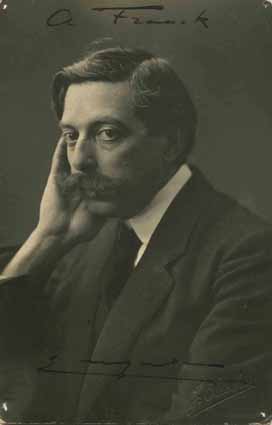
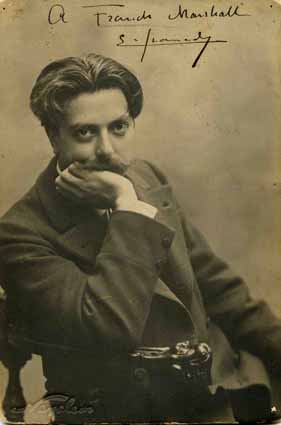
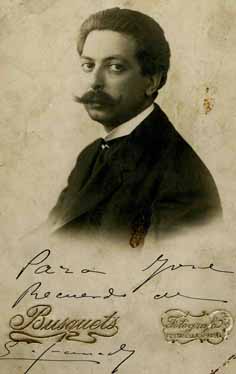
Specific Bibliography |
|||
| Title | Author | Published by |
Year |
| La música i el Modernisme | Aviñoa, Xosé |
Biblioteca de cultura catalana. Barcelona |
1985 |
|
Gran enciclopedia catalana |
Varis autors |
Enciclopedia catalana, S.A. |
|
|
|
Antoni Carreras i Granados |
Ed.de Nou Art Thor, Barcelona |
1988 |
|
Barcelona filarmónica. La evolución musical de 1875 a 1925 |
Lamaña, L. |
Elzeviriana i Libr. Camí, S.A Barcelona |
1927 |
|
La música a Catalunya |
Lamote de Grignon |
Conferència mecanografiada ca.1937. Arxiu Sra. Empar Ranch, Valencia. |
ca. 1937 |
|
Musique et musiciens français a Barcelone, musique et musiciens catalans à Paris |
Lamote de Grignon |
Conferència mecanografiada, llegida a l’Institut Francès de Barcelona el 9-5-1935 |
1935 |
| Quasi un segle de simfonisme a Barcelona. Vol I: De l’orquestra Pau Casals a L’Orquestra Ciutat de Barcelona | Martorell, Oriol | Barcelona | 1995 |
| Síntesi històrica de la música catalana | Martorell, Oriol i Valls Manel | Els llibres de la frontera. Sant Cugat del V. | |
| El rossinyol abatut. Enric Granados (1876-1916 una vida apassionada | Milton, John W. | Pagès editors – Lomarraco | 2005 |
| Acadèmia Granados-Marshall: 100 anys d’escola pianística a Barcelona | Pagès Santacana, Mònica | Taller editorial Mateu | 2000 |
|
Història de la Música Catalana |
Valls, M. |
Editorial Tàber. Barcelona |
1969 |
|
Gran enciclopèdia catalana |
Varis autors |
Enciclopèdia catalana, S.A. |
|
Other Art Nouveau Catalan Musicians:
—Isaac ALBÉNIZ i Pascual—Enric GRANADOS i Campiña—Joan LAMOTE DE GRIGNON i Bocquet–Antoni Laporta i Astort–APEL·LES MESTRES i Oñós–Lluís MILLET i Pagès—Enric MORERA i Viura–Antoni NICOLAU i Parera–Jaume Pahissa i Jo–Felip Pedrell i Sabaté–Josep Ribas i Gabriel–Amadeu Vives i Roig
