Joan Brull i Vinyoles (1863-1912)
Basic Works
Historical period:
La tonsura de Wamba (The tonsure of Wamba)
Mythologie:
Nimfes al capvespre (Nymphs at dusk)
Safo (Sappho)
Realistic period:
Amigues (Friends)
Bust de dona (Lady bust)
Cap de captaire (Head of a beggar)
Cap de jove (Head of a young men)
Després del treball (After work)
El pessebre (Nativity scene)
Nena donant menjar a una oca (Young girl with a goose – MNAC)
Maturity:
Cap de dona (Lady head)
Contes de l’avi (Granfather stories)
Dama a un jardí (A lady in a garden)
Ensomni (Dream)
Idil·li (Idyll)
Misticisme (Mysticism)
Nadal (Christmas)
Noia que fa mitja (Girl kniting plain)
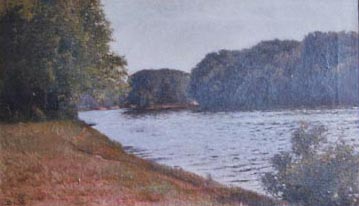
Primavera al riu (Spring at the river)
Reverie (1898)
Life
Born in Barcelona in the year 1863.
Joan Brull studied art at the School Llotja in Barcelona, at the same time as other painters of the period.
He was initially interested in historical themes, which he developed in a totally figurative style. An example of his work from this period is the picture “La tonsura de Wamba”. Another theme frequently developed by Brull during this time was mythology, painting subjects such as “Nimfes al capvespre” (Nymphs at dusk) and Safo (Sappho).
He was very much influenced by Modernisme (Art Nouveau), and became an important member of the movement.
His mature period started around 1885, and is characterized by sentimentalism, tenderness and a melancholic inspiration, which are manifested in his works Ensomni, Idil·li and Misticisme.
In addition to his activity as a painter, he also was an art critic.
Joan Brull died in Barcelona in 1912.
Other Catalan Art Nouveau Painters
-Hermen ANGLADA i Camarassa -Joan BRULL i Vinyoles -Ricard Canals -Agapit Casas i Abarca -Ramón CASAS i Carbó -Josep CUSACHS -Manuel Cusí
-Xavier Gosé i Rovira -Sebastiá Junyent -Joan Llimona i Bruguera -Josep Maria Marqués -Francesc MASRIERA i Manovens -Josep MASRIERA I Manovens -Lluis MASRIERA i Rosés -Eliseu MEIFRÈN i Roig -Joaquim MIR i Trinxet -Francesc Miralles -Isidre NONELL i Monturiol -Marià PIDELASERRA i Brias -Josep Pinós i Comes -Josep Reynés -Alexandre Riquer i Ynglada -Pau Roig i Sisa -Santiago RUSIÑOL i Prats -Antoni Serra i Fiter -Josep Maria Tamburini -Modest Urgell -Miquel UTRILLO i Morlius -Lluïsa VIDAL i Puig -Pere Ysern i Alié
